



Carotone Brightening Cream vs Dark Spot Serums: Safety & What to Compare
Carotone brightening creams and dark-spot serums should not be compared by a simple “which works better?” ranking. The first questions are what the current product actually contains, whether the formula is legally marketed where you live, and whether its claims fit the product category.
This matters because regulators have recently raised safety concerns about some imported CAROTONE products. On August 25, 2026, Australia’s Therapeutic Goods Administration reported that three imported CAROTONE products it tested contained undeclared hydroquinone above 2% and advised consumers not to use those tested products. The TGA also classified those tested products as counterfeit under Australian law. See the TGA safety advisory.
Why Carotone requires extra label scrutiny
Carotone-branded products may appear in different markets, packaging versions, and seller channels. Because regulator testing has identified undeclared hydroquinone in some imported CAROTONE products, shoppers should not rely on old ingredient lists, marketplace descriptions, or third-party rankings.
Check the exact current package in your hand, the seller, the country where the product is being sold, and any regulator warnings that apply.
What the FDA says about OTC skin-lightening products
In the United States, the FDA states that over-the-counter skin-lightening products containing hydroquinone are not FDA-approved or legally marketed without an approved drug application. The agency also warns that skin-lightening products containing hydroquinone or mercury may cause harm. See FDA skin-lightening safety guidance.
FDA-reported risks linked to hydroquinone-containing skin-lightening products include rashes, facial swelling, and ochronosis, a discoloration that may be permanent.
Brightening cream vs. dark-spot serum: what is the real difference?
The format itself does not determine effectiveness.
| Feature | Brightening Cream | Dark-Spot Serum |
|---|---|---|
| Texture | Usually richer and more emollient | Usually lighter and easier to layer |
| Primary role | Moisture plus any brightening actives included | Targeted cosmetic treatment step |
| Better for dark spots? | Depends on formula | Depends on formula |
| Needs sunscreen alongside? | Yes | Yes |
Ingredients commonly used for uneven-looking tone
- Vitamin C: used for antioxidant and brightening support.
- Niacinamide: supports the skin barrier and a more even-looking complexion.
- Alpha arbutin: a cosmetic brightening ingredient used in targeted formulas.
- Azelaic acid: used in both cosmetic and medical contexts depending on strength and product type.
- Retinoids: may help certain pigmentation and photoaging concerns but can irritate sensitive skin.
Do not assume that a product marketed as “brightening,” “bleaching,” “whitening,” or “spot correcting” is automatically equivalent to another product using the same marketing language.
A verified Glimmer Goddess dark-spot serum option
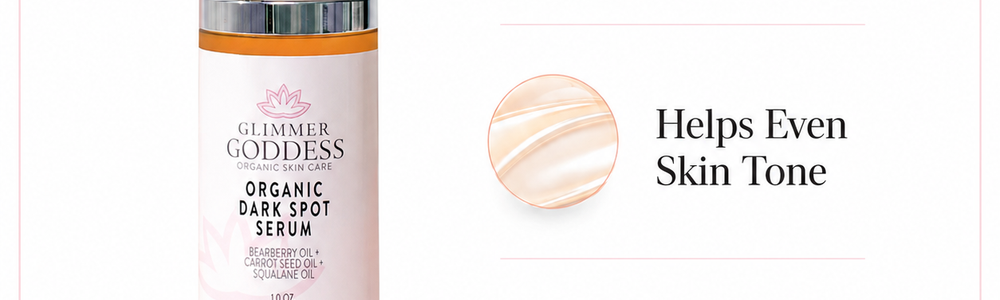
The Organic Dark Spot Serum – Fade Hyperpigmentation & Even Skin Tone is a verified Glimmer Goddess serum formulated with alpha arbutin, plant-based vitamin C, niacinamide, and botanical brightening ingredients.
It is also verified as hydroquinone-free.
Its appropriate cosmetic role is to help improve the appearance of visible dark spots and uneven tone. It should not be positioned as a prescription treatment, a bleaching drug, or a guaranteed cure for melasma.
How to compare a product safely before buying
- Read the exact current ingredient label.
- Check the seller and country of sale.
- Look for current regulator alerts.
- Separate cosmetic brightening claims from drug treatment claims.
- Avoid products with undeclared or unclear active ingredients.
- Use broad-spectrum SPF 30 or higher during dark-spot care.
Why sunscreen matters more than cream vs. serum
Sun and visible-light exposure can make hyperpigmentation more persistent. The American Academy of Dermatology recommends broad-spectrum SPF 30 or higher and notes that tinted sunscreen containing iron oxide can be especially useful for some pigmentation concerns. See AAD dark-spot guidance.
What if the discoloration is melasma?
Melasma is a specific pigmentation disorder and often needs dermatologist-guided treatment. A cosmetic brightening cream or serum may support the appearance of more even tone, but it should not be described as equivalent to prescription treatment.
When should you avoid a skin-lightening product?
Avoid a product and seek medical advice if:
- the ingredient list is missing or unreliable;
- the product contains hydroquinone but is being sold OTC in the U.S. without proper approval;
- the seller cannot verify authenticity;
- you develop swelling, rash, burning, or unusual discoloration;
- a regulator has specifically warned against the exact product you purchased.
Frequently asked questions
Is Carotone banned?
It would be inaccurate to say every Carotone product everywhere is universally banned. However, Australia’s TGA warned against specific imported CAROTONE products it tested in August 2026 after finding undeclared hydroquinone above 2%.
Does every Carotone product contain hydroquinone?
That cannot be assumed. The regulator finding applies to specific tested imported products. Verify the exact product and current label rather than generalizing across the entire brand.
Is a cream better than a serum for dark spots?
No. The ingredient system, formulation quality, skin tolerance, and consistency of use matter more than whether the product is called a cream or serum.
Is hydroquinone available over the counter in the U.S.?
The FDA says OTC skin-lightening products containing hydroquinone are not approved for over-the-counter sale in the United States.
Does the Glimmer Goddess Dark Spot Serum contain hydroquinone?
No. The live formula is verified as hydroquinone-free and uses alpha arbutin, plant-based vitamin C, niacinamide, and botanical brightening ingredients.
Related Glimmer Goddess guides
- Skincare for Dark Spots: Ingredients, Routine & What to Expect
- How to Layer Dark Spot Ingredients: AM & PM Routine
- Sunscreen for Dark Spots: SPF, Tinted Sunscreen & Routine
- Explore Skincare by Skin Concern
This article is for general skincare education and shopping guidance and is not a diagnosis or substitute for medical care.