




How to Build a Skincare Routine: What You Actually Need
The best skincare routine is not the one with the most products—it is the one that covers the basics and solves your main skin concern without creating unnecessary irritation. For most people, a useful foundation is gentle cleansing, one targeted treatment if needed, moisturizer, and daily broad-spectrum sunscreen.
The American Academy of Dermatology recommends keeping routines simple, applying treatment after cleansing, then moisturizer and/or sunscreen, and avoiding unnecessary product overload because too many actives can irritate the skin. See AAD skincare-order guidance.
The four core skincare steps
1. Cleanser
A cleanser should remove sunscreen, makeup, oil, and daily buildup without leaving your skin persistently tight or uncomfortable.
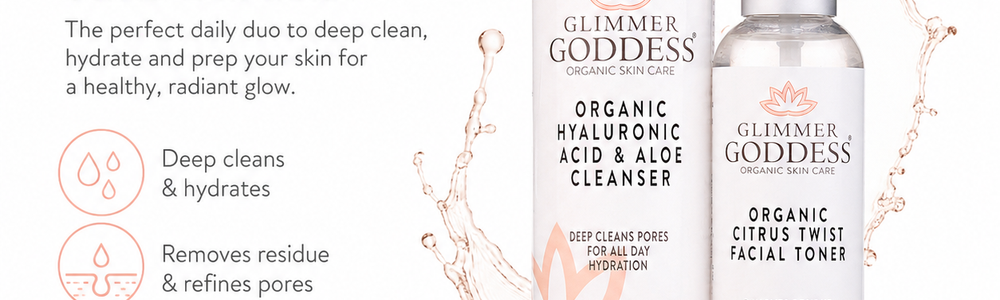
The Fresh Start Duo – Hydrating Cleanser & Toner is a verified Glimmer Goddess set that pairs a hyaluronic-acid facial cleanser with a Rose Water Toner.
You do not need a toner for a complete routine, but it can be an optional prep step if your skin tolerates it well.
2. One targeted treatment
Choose a serum or active based on your main concern rather than layering several trend-driven products at once.
- Brightening: the Organic Vitamin C Serum 20% – Brightening Treatment with Hyaluronic & Ferulic Acid.
- Hydration: the Organic Hyaluronic Acid Serum – Plumping Hydration 1 oz..
One well-chosen serum is usually more useful than stacking multiple products that perform the same job.
3. Moisturizer
Moisturizer helps reduce water loss and support skin comfort. The right texture depends on your skin type, climate, and the other products in your routine.
The AAD recommends applying moisturizer to damp skin and notes that even oily skin may benefit from moisturizer when it feels dry or when acne treatments are irritating. See AAD moisturizer guidance.
4. Sunscreen
Broad-spectrum SPF 30 or higher belongs in the morning routine. The AAD considers sunscreen one of the most important daily products for reducing UV-related premature aging and helping prevent visible dark spots from worsening. See AAD sunscreen guidance.
The Triple Action Daily Moisturizer – Organic SPF 30 is a verified GG morning option that combines hydration with mineral SPF 30.
How to choose products by skin concern
Dry or dehydrated skin
Focus on gentle cleansing, a hydrating serum if useful, and a moisturizer rich enough to keep the skin comfortable.
Oily or acne-prone skin
Choose lightweight, non-comedogenic products and avoid over-cleansing. Salicylic acid can be useful for clogged pores and blackheads, but stronger or more frequent use is not automatically better.
Dark spots or uneven tone
Use one brightening treatment consistently and prioritize daily sunscreen. Vitamin C, niacinamide, alpha arbutin, azelaic acid, and retinoids may all play a role depending on the formula and your skin tolerance.
Fine lines and visible aging
Start with sunscreen and moisturizer. Retinoids have stronger evidence for mild fine lines and texture than most cosmetic actives, but they can also irritate and should be introduced gradually.
Sensitive skin
Keep the routine simple, introduce one product at a time, and favor fragrance-free options when fragrance is a known trigger. Patch testing can help identify potential reactions before full-face use.
How to layer skincare in the morning
- Gentle cleanser.
- Optional targeted serum.
- Moisturizer if needed.
- Broad-spectrum SPF 30 or higher.
- Makeup, if desired.
How to layer skincare at night
- Gentle cleanser.
- One treatment or serum.
- Moisturizer.
If you are using prescription medication or a dermatologist-directed treatment, follow those instructions instead of a generic layering rule.
Do you need a 10-step routine?
No. A simple routine that you use consistently is usually more useful than a long routine you cannot maintain.
What skincare claims should you ignore?
- Invented product scores without transparent testing.
- Claims that “natural” automatically means safer.
- Promises that every skin type will see the same result on the same timeline.
- Fear-based claims that entire regulated ingredient classes are “toxic.”
- Products promising overnight or permanent wrinkle removal.
- Routines that insist everyone needs the same number of steps.
How to introduce new products
Add one new product at a time when possible. That makes it easier to tell what your skin tolerates and which product is actually helping.
The AAD recommends testing new skincare on a small area twice daily for 7 to 10 days before broader use if you are concerned about a reaction.
Frequently asked questions
What are the most important skincare products?
For most people: cleanser, moisturizer, and daily broad-spectrum sunscreen. Add targeted treatments only when they address a real concern.
Do I need both serum and moisturizer?
Not always. A serum is optional. Moisturizer plays a different role by helping reduce water loss and support skin comfort.
Are expensive products better?
No. Formula quality, skin compatibility, packaging, and consistency matter more than price alone.
Should I change my routine every season?
You may need to adjust texture or frequency as climate and humidity change, but you do not necessarily need an entirely new routine.
When should I see a dermatologist?
Seek professional care for persistent acne, changing lesions, ongoing rash, significant irritation, suspected eczema or rosacea, or concerns that do not improve with a reasonable routine.
Related Glimmer Goddess guides
- How to Layer Skincare Products: The Right Order for AM & PM
- Skincare for Oily Skin: Routine, Ingredients & What to Avoid
- Skincare for Dry Skin: Products, Routine & Barrier Support
- Explore Skincare by Skin Concern
This article is for general skincare education and is not a diagnosis or substitute for medical care.