

Best Face Brightening Creams 2026: 5 Compared
Which face brightening cream should you choose in 2026? Start by deciding whether you want your skin to look more luminous because it is better hydrated, you want help with the appearance of uneven pigment, or you need daytime sun protection. Those are related but different goals. The best moisturizer is one that fits the job and feels comfortable enough to use consistently; no face cream is proven best for every complexion.
This guide compares five actual creams from Glimmer Goddess, SkinCeuticals, La Roche-Posay, Olay and CeraVe. We preserve the original five-brand comparison but replace entries that were mistakenly categorized as creams, including a SkinCeuticals serum and a La Roche-Posay cleanser. We also remove scores that had no documented testing method.
Editorial disclosure: Glimmer Goddess publishes this article and sells one of the five creams. We have not independently tested these products head-to-head, assigned clinical rankings or established that our cream is more effective than competitors.
At a glance: five face creams for different radiance goals
| Cream | Best match for | What to know |
|---|---|---|
| Glimmer Goddess Copper Peptide Moisturizer | Hydration, smoother-looking skin and peptide-focused care | Not a clinically established pigment-correcting treatment |
| SkinCeuticals Triple Lipid Restore 2:4:2 | Dryness-related dullness and skin comfort | A lipid cream, not the H.A. Intensifier serum |
| La Roche-Posay Mela B3 UV Daily Moisturizer SPF 30 | Tone-focused daily moisturizing and UV protection | SPF protection requires correct application and reapplication |
| Olay Regenerist Micro-Sculpting Cream | Niacinamide, peptides and smoother-looking texture | Original standard cream contains fragrance; versions differ |
| CeraVe Moisturizing Cream | Dry or sensitive skin needing comfortable moisture | Not a specialized brightening treatment |
These products are not interchangeable. A hydration-first cream may make dry skin appear brighter without addressing melanin-related dark spots. A daytime SPF moisturizer can be part of pigment prevention, while a peptide-focused cream may emphasize texture and softness.
1. Glimmer Goddess Organic Copper Peptide Moisturizer — peptide-focused moisture
Our Organic Copper Peptide Moisturizer – Firming & Smoothing is an active product in Glimmer Goddess Shopify. It belongs in a cream comparison because it is a moisturizer, unlike our separately sold Copper Peptide Serum.
Why consider it: You enjoy small-batch, botanical-focused skincare and are looking for moisturization alongside a cosmetic peptide-focused formula for a smoother, firmer-looking complexion. Better hydration alone can help reduce the appearance of dull, dry texture.
What it cannot promise: The mere presence of copper peptides does not prove that a cream erases dark spots, regenerates human skin or is safer than every other formula. It has not been independently compared with the other four creams in this article. Do not assume every Glimmer Goddess formula is fragrance-free or suitable for someone with reactive skin; check the current product and variant ingredients.
2. SkinCeuticals Triple Lipid Restore 2:4:2 — radiance through hydration
SkinCeuticals Triple Lipid Restore 2:4:2 is an authentic facial moisturizer built around the manufacturer's stated ratio of 2% ceramides, 4% cholesterol and 2% fatty acids. The brand positions it for improved visible fullness, texture and radiance associated with skin moisture and lipid support.
Why consider it: Dehydration and dry texture make your complexion look less luminous, and you want a richer lipid-focused cream. It can play a useful supporting role alongside other products.
Important distinction: The original article included SkinCeuticals H.A. Intensifier, which is a serum, not a face cream. This corrected entry is a moisturizer. Even when a manufacturer provides product-specific study results, those figures should not be interpreted as independent comparative proof against other brands.
3. La Roche-Posay Mela B3 UV Daily Moisturizer SPF 30 — tone-focused daytime care
La Roche-Posay Mela B3 UV Daily Moisturizer SPF 30 is a true moisturizer and sunscreen containing the brand's Melasyl ingredient and 5% niacinamide. La Roche-Posay positions it for uneven-looking tone and daily protection from UVA and UVB exposure.
Why consider it: You are particularly concerned with uneven pigment and want a daily moisturizer that incorporates SPF. That makes it more directly relevant to a dark-spot-oriented purchase than a basic moisturizing cream alone.
Important distinction: La Roche-Posay Toleriane Purifying Foaming Cleanser was incorrectly placed in the original cream ranking. It is a cleanser, not a leave-on brightening cream. A product labeled SPF 30 must be used in the correct amount and reapplied as directed to provide its labeled sun protection. Manufacturer claims for Mela B3 do not prove it outperforms all other creams.
4. Olay Regenerist Micro-Sculpting Cream — niacinamide and peptides
Olay Regenerist Micro-Sculpting Cream is a moisturizing formula with niacinamide, panthenol and peptides according to Olay's current ingredient information. This makes it a relevant option for skin that looks dull because of dryness or surface texture.
Why consider it: You prefer a widely available moisturizer that includes niacinamide and peptide ingredients. Niacinamide appears in many formulations for barrier support and more even-looking skin.
What to check: The standard version's published ingredient list includes fragrance, while Olay also offers other versions. Review the precise product rather than assume every Regenerist moisturizer contains retinol or that every version is fragrance-free. The original article treated “Olay Regenerist Advanced Anti-Aging Cream” as though it were one clearly identified retinol product; this has been corrected to a verifiable item.
5. CeraVe Moisturizing Cream — a supportive cream for dry skin
CeraVe Moisturizing Cream includes three essential ceramides, hyaluronic acid, petrolatum and dimethicone. The brand describes it as a fragrance-free facial and body moisturizer suitable for normal-to-dry skin.
Why consider it: Your skin's main problem is dryness or tightness rather than a confirmed pigmentation disorder. Moisturization can improve the appearance of rough or dehydrated skin and may support tolerance when using a separate targeted active.
What it does not do: It is not marketed as a specialized dark-spot correction cream. Its formula's value is hydration and comfort; this is not evidence that it is ineffective, nor that customers need a more expensive moisturizer. Some skin types may prefer a lighter format, but texture suitability is individual.
What does “brightening” actually mean?
Brands use “brightening” for at least three distinct cosmetic effects. The first is hydration-related radiance, when dry skin looks smoother and reflects light more evenly. The second is visible pigment-related unevenness, such as marks left after acne or patches influenced by sun exposure. The third is immediate optical glow, often created by reflective cosmetic particles.
These results should not be confused. A peptide moisturizer may support smoother-looking skin but does not automatically treat hyperpigmentation. A moisturizing product with vitamin C or niacinamide may have a tone-focused purpose, but performance depends on the finished formula, not merely on a recognizable ingredient name.
Ingredients to understand before buying
Vitamin C and other antioxidants
Topical vitamin C can support brighter-looking skin in some well-formulated products, but effectiveness varies by form, concentration, stability, packaging and tolerance. A particular percentage is not universally optimal. Vitamin C does not replace UV protection.
Niacinamide
Niacinamide is a form of vitamin B3 included in moisturizers and serums for barrier support and cosmetic evenness. Its presence alone does not guarantee the same outcome across every brand. Concentration and other ingredients matter, and some users may react to individual formulas.
Copper peptides and other peptides
Peptides differ widely. Cosmetic formulas may be intended to improve the visible appearance of texture and firmness, but broad claims that any peptide cream directly regenerates skin or erases pigmentation are not warranted without product-specific evidence.
Ceramides, glycerin and hyaluronic acid
These are common moisturizing ingredients. Ceramides are related to the skin barrier, while glycerin and hyaluronic acid help bind water. Comfortable hydration can temporarily soften the look of fine lines and surface dullness, although these ingredients are not by themselves a solution to every dark spot.
Acids and retinoids
Some products use AHAs, retinoids or other active ingredients to address visible texture and photoaging. These may cause irritation or sun sensitivity, particularly when layered without care. They are not necessary in every brightening routine and may be inappropriate for some sensitive skin. Pregnant people should avoid retinoids and discuss stronger skincare ingredients with a clinician.
How to choose based on your skin
Dry skin: If your main concern is a tight, dull-looking complexion, start with a moisturizer you find comfortable. Ceramide-focused or lipid-rich creams may be useful; a brightening serum is optional.
Oily or combination skin: Choose a texture you will use consistently rather than assume every rich cream clogs pores. A lighter moisturizer may be preferable in warm climates. For persistent acne or blackheads, a dedicated acne routine is a separate consideration.
Sensitive skin: A fragrance-free option may be a sensible starting point. Do not assume natural fragrance is safer than synthetic fragrance: essential oils can trigger contact reactions. Avoid over-exfoliating or trying several unfamiliar active creams together.
Mature skin: Hydration can soften dryness lines and leave skin looking more luminous. Sunscreen remains an important morning step because cumulative sun exposure contributes to visible aging.
Uneven pigmentation: Prioritize sun protection and a product specifically positioned for the appearance of uneven tone. Some cases such as melasma or persistent post-inflammatory hyperpigmentation merit dermatologist guidance.
The essential role of sunscreen
According to the American Academy of Dermatology, protection against UV exposure is a foundational part of caring for visible dark spots. For pigment changes affected by visible light, such as some cases of melasma or discoloration in deeper skin tones, a tinted sunscreen containing iron oxides may be particularly useful.
Use a broad-spectrum SPF 30 or higher and follow its application and reapplication directions. A moisturizer containing SPF is a sunscreen product when used as labeled, not when applied in a tiny decorative amount. An untinted sunscreen should not be assumed to offer identical visible-light protection to one with iron oxides.
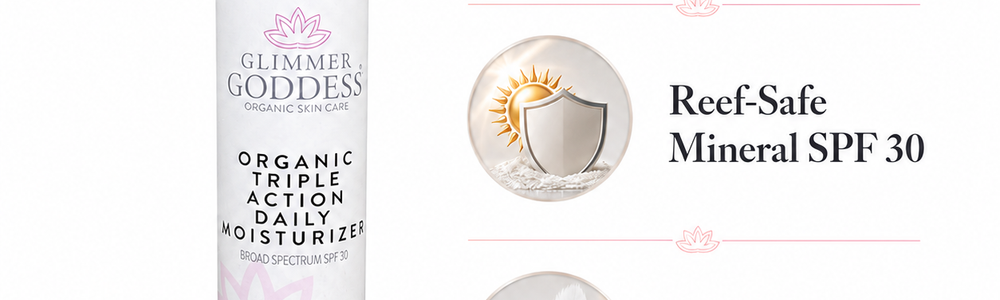
If you prefer a Glimmer Goddess daytime moisturizing SPF option, our Organic Vitamin C Daily Moisturizer SPF 30 is an active Shopify product with that purpose. It is a separate formula from the Copper Peptide Moisturizer featured above. Check current usage and ingredient details.
Build a simple brightening routine
Morning
- Cleanse gently if needed.
- Apply one optional targeted serum according to its directions; toner is not required.
- Moisturize as appropriate. If your moisturizer is also your sunscreen, use adequate sunscreen amounts.
- Follow sun-protection instructions and reapply SPF when indicated, especially outdoors.
Evening
- Remove makeup and sunscreen without scrubbing aggressively.
- Use an optional active treatment only if it fits your goals and tolerance.
- Apply a comfortable moisturizer to help manage dryness.
- Stop any product causing persistent burning, swelling or rash, and seek medical advice when necessary.
A “brightening toner,” exfoliating mask or separate eye cream is not mandatory just because it appears in a skincare marketing routine. More steps do not guarantee faster results. Follow the specific formula directions rather than a universal rule to wait sixty seconds between every application.
What to avoid when shopping for face creams
Unsupported rankings: A numerical score without transparent testing is not evidence that one cream is superior. Look for the actual ingredient list and intended function.
Vague promises of permanent spot removal: Some marks fade gradually, some persist, and some require medical diagnosis. No ordinary cosmetic erases every type of pigmentation.
Assuming natural is non-irritating: Botanical extracts and essential oils can be allergens. Review the exact formula, especially when shopping for reactive skin.
Comparing different formats as though they are identical: A cleanser is not a leave-on cream, and a serum is not automatically a moisturizer. Choose the type of product that matches the step you need.
Assuming the first ten ingredients prove efficacy: An ingredient's placement on the label cannot by itself establish clinical effectiveness; many ingredients work at relatively low concentrations, and finished-formula testing matters.
Realistic expectations
A moisturizing cream may make skin appear smoother relatively quickly by improving hydration. Changes in pigmentation can take much longer and vary based on cause, depth, skin tone, UV exposure and individual response. The AAD notes that some dark marks can take six to twelve months to fade after the underlying cause is controlled, while deeper discoloration can persist for years.
New, changing, bleeding or irregular lesions warrant medical evaluation rather than a cosmetic trial. A dermatologist can distinguish different forms of pigmentation and advise when prescription care is appropriate.
Frequently asked questions
Is a brightening face cream the same as a dark spot serum?
No. Some creams incorporate tone-related actives; others mainly hydrate. A serum is a distinct product format and may have a different concentration or purpose. Compare the finished formulas, not the names alone.
Can I use a brightening cream if I have sensitive skin?
Possibly, but choose based on your specific sensitivities. A fragrance-free basic moisturizer may be better than a strong active treatment during irritation. Even natural ingredients can cause reactions.
Will copper peptides erase dark spots?
We do not have evidence that the Glimmer Goddess Copper Peptide Moisturizer universally erases pigmentation. It is best understood as a moisturizing, peptide-focused cosmetic cream rather than a medical dark-spot treatment.
Do I need to use a brightening cream twice daily?
Not necessarily. Use products according to their specific directions. SPF creams belong in daytime routines and require appropriate application; some treatment creams are intended for once-daily or evening use.
Can moisturizer make my complexion look brighter without pigment change?
Yes. A more hydrated skin surface may look smoother and less dull even when underlying pigmentation is unchanged.
Does vitamin C make my skin photosensitive?
Vitamin C itself is not generally regarded as photosensitizing in the same way that some exfoliating acids can be. Sunscreen remains important to help prevent UV-related damage and worsening pigmentation.
Can creams remove melasma?
No cosmetic product guarantees resolution of melasma. Sun and visible-light protection and professional advice may be important for this persistent condition.
Explore related Glimmer Goddess guides
For more focused shopping questions, read our five creams by skin need, five face creams for visible pigmentation, and complete dark spots skincare guide. These are related but distinct comparisons for readers with different priorities.
Editorial disclosure: Glimmer Goddess® sells one of the five products featured here. Other brand descriptions are based on publicly available manufacturer information, not independently conducted clinical tests. This article is general skincare education, not medical advice.