

Handmade Face Moisturizer: What Small-Batch Skincare Really Means
“Handmade” and “small-batch” can tell you something about how a face moisturizer is produced, but those words do not prove that the formula is safer, fresher, more potent or better for every skin type. A good moisturizer still needs an appropriate formula, safe preservation, accurate labeling and a texture you will use consistently.
What Small-Batch Skincare Actually Means
Small-batch production generally means a brand manufactures products in relatively limited runs instead of very large industrial batches. Glimmer Goddess® products are handmade in small batches in the USA, which is part of how we approach production and quality control.
That manufacturing style is a brand and process choice—not clinical evidence that every small-batch formula outperforms a mass-produced one.
What “Handmade” Does Not Guarantee
- It does not automatically mean preservative-free.
- It does not prove a product is hypoallergenic.
- It does not mean every ingredient is organic.
- It does not guarantee a longer or shorter shelf life.
- It does not make a product appropriate for every skin type.
Water-containing skincare needs a preservation strategy appropriate to the formula. “Natural” or “handmade” should never be used as a reason to dismiss microbiological safety.
Does Organic Mean Safer?
Not automatically. The FDA states that an ingredient’s source does not determine its safety; organically grown plants can still contain irritating or allergenic substances. In the United States, FDA does not itself define “organic” for cosmetics, while USDA’s National Organic Program governs eligible organic agricultural claims and certification.
For shoppers, the more useful questions are: What is in the finished formula? Is it appropriate for my skin? How is it packaged and preserved? What claims are actually supported?
What to Look for in a Face Moisturizer
1. A texture that fits your skin
Dry skin may prefer a richer cream, while oilier or humid-weather skin may prefer a lighter lotion or gel. There is no prestige benefit to forcing a texture that feels uncomfortable.
2. Humectants, emollients and barrier-supportive ingredients
Moisturizers work through combinations of ingredients that attract water, soften the skin surface and help reduce water loss. The finished formula matters more than a single trendy ingredient.
3. Claims that match the product category
A face cream can support moisture, comfort and a smoother-looking surface. It should not be expected to produce the same result as a medical procedure or treat a skin disease unless it is legally positioned for that purpose.
4. Appropriate daytime sun protection
If your daytime moisturizer includes sunscreen, check the labeled SPF and use it according to sunscreen directions. The active Triple Action Daily Moisturizer – Organic SPF 30 is a current Glimmer Goddess® moisturizer-with-SPF option.
What About Night Cream?
Night cream is simply a moisturizer designed for an evening routine; it does not become more effective merely because it is labeled “night.” A richer nighttime texture can be useful if your skin feels dry after cleansing or treatment steps.
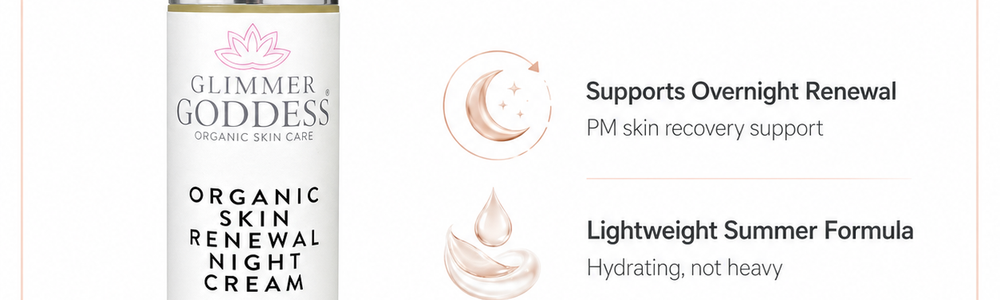
The current Organic Skin Renewal Night Cream 2 oz – Anti-Aging is an active Glimmer Goddess® night moisturizer. Its practical role is overnight moisture and skin-conditioning support; the product title should not be interpreted as a promise to reverse biological aging.
How to Layer Moisturizer Without Overcomplicating It
- Cleanse gently.
- Apply any treatment or serum you use.
- Apply moisturizer.
- In the morning, finish with sunscreen if your moisturizer does not already provide your chosen sunscreen step.
For more detail, see How to Layer Skincare Products: The Right Order for AM & PM.
If you are deciding whether you need both a serum and cream, our serum + moisturizer guide for mature or dry skin explains when two steps make sense.
Small Batch vs. Mass Produced: Which Is Better?
Neither production scale automatically wins. Large manufacturers may have extensive automated controls; small-batch makers may offer close hands-on oversight and flexibility. The meaningful evaluation points are formula quality, manufacturing controls, labeling, safety, stability and whether the product fits your skin.
Frequently Asked Questions
Does handmade skincare need preservatives?
Some formulas do. Products containing water can require an appropriate preservation system to limit microbial growth. The answer depends on the formula.
Is handmade moisturizer better for sensitive skin?
Not inherently. Sensitive skin can react to botanical extracts, essential oils, fragrance components or conventional ingredients. Evaluate the finished ingredient list and patch test when appropriate.
Is a day cream different from a night cream?
Often by texture or included features such as SPF, but the labels alone do not determine quality. Choose based on how the formula fits the time of day and your skin needs.
The Bottom Line
Small-batch craftsmanship can be part of a brand’s identity and manufacturing approach, but skincare performance still comes down to the finished formula. Choose a moisturizer for comfort, moisture needs, formulation quality and appropriate sun protection—not because “handmade” or “organic” sounds automatically safer.
Sources: U.S. FDA: “Organic” Cosmetics; American Academy of Dermatology: choosing a moisturizer.