


Organic vs. Conventional Face Masks: What the Label Really Tells You
An “organic” face mask is not automatically safer, gentler or more effective than a conventional face mask. In the United States, FDA does not define the term “organic” for cosmetics; eligible agricultural ingredients and products may fall under USDA organic standards. FDA also states that an ingredient’s source does not determine cosmetic safety.
What “Organic” Means on a Cosmetic
USDA’s National Organic Program can apply to cosmetics, body care and personal care products that contain qualifying agricultural ingredients and meet applicable production, handling and labeling requirements. Different organic labeling categories depend on composition and certification status.
At the same time, every cosmetic still has to comply with applicable FDA requirements. An organic claim does not exempt a product from cosmetic safety or labeling rules.
What the Organic Label Does Not Tell You
It does not tell you whether a face mask will:
- work for your skin type;
- avoid irritation or allergy;
- treat acne, eczema or another skin disease;
- be stronger or gentler than another mask;
- deliver a specific anti-aging result.
Plants can contain allergens and irritants whether they are conventionally or organically grown. Likewise, synthetic ingredients are not automatically unsafe simply because they are synthetic.
Compare the Formula, Not the Fear Language
When choosing a mask, focus on what the formula is designed to do. The American Academy of Dermatology recommends matching ingredients to your skin concern and avoiding redundant actives that can increase irritation.
For surface oil
Clay ingredients such as kaolin or bentonite can absorb oil. They may be useful for oily areas, but can feel drying on already-dry skin.
For texture and exfoliation
AHAs and enzyme-based formulas can loosen dull surface buildup. Their intensity and irritation potential depend on the specific formula, contact time and your skin.
For dull-looking skin
Antioxidant or brightening-focused masks may temporarily improve radiance, but they should not be framed as medical treatment for pigmentation disorders.
Examples From the Current Glimmer Goddess® Mask Line
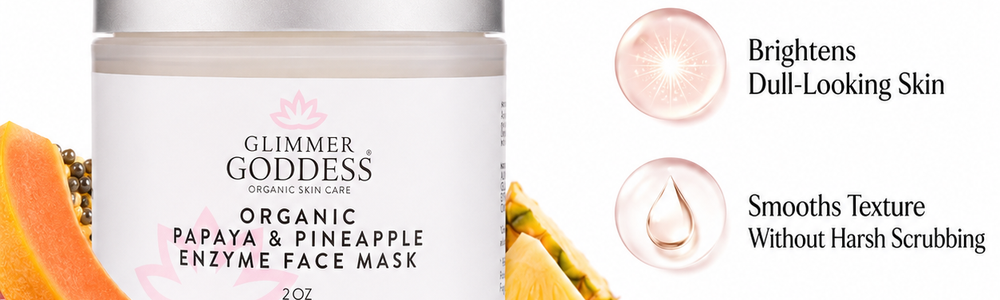
The active Organic AHA Face Mask – Renewing Treatment for Exfoliation & Glow is an exfoliation-focused option. The active Organic Papaya Pineapple Enzyme Face Mask – Gentle Exfoliating Treatment uses an enzyme-focused format. The word “organic” in the product family does not replace the need to consider the individual formula and your tolerance.
Natural Does Not Mean Non-Irritating
Essential oils, fragrant botanicals and fruit-derived ingredients can irritate some people. Conversely, many conventional cosmetic ingredients have long safety histories when used appropriately.
If your skin is reactive, patch testing and a shorter ingredient list may be more useful decision tools than simply choosing between “natural” and “synthetic.”
Should You Avoid Conventional Face Masks?
No broad rule supports avoiding all conventional masks. A well-formulated conventional mask may be a better fit for one person than an organic mask, and the reverse can be true for someone else.
The more useful question is: Does this particular product fit my skin concern and routine without duplicating irritating actives?
How This Fits With the Rest of Your Mask Routine
For help rotating different formulas, see Can You Use More Than One Face Mask? How to Rotate Masks Safely.
If you are comparing exfoliating formats specifically, see AHA Mask vs. Enzyme Mask. For a broader evidence-based overview, read Are Face Masks Good for Your Skin? Benefits, Limits & Safe Use.
Frequently Asked Questions
Are organic face masks safer?
Not automatically. FDA states that an ingredient’s source does not determine its safety.
Are synthetic ingredients bad for skin?
No. “Synthetic” is not a safety category. Safety depends on the specific ingredient, concentration, formulation and intended use.
Does organic mean vegan?
No. Organic and vegan describe different attributes. Glimmer Goddess® follows a strict vegan standard, but shoppers should not assume every organic cosmetic from every brand is vegan.
The Bottom Line
Use organic labeling as one piece of product information—not as a shortcut for safety or effectiveness. Compare the complete formula, the mask’s purpose, your skin history and how it fits with the rest of your routine.
Sources: U.S. FDA: “Organic” Cosmetics; USDA: Cosmetics, Body Care and Personal Care Products; American Academy of Dermatology: facial masks and skincare.