



DHA vs. DHA-Free Self Tanner: Lotion, Drops & How to Choose
“Self-tanner” is a category, not one single formula. Some sunless tanners use DHA, while DHA-free options can use another color-forming ingredient such as erythrulose. You can also choose between ready-to-apply lotions and concentrated drop formats. The best option depends on how quickly you want color, how you prefer to apply it and which finished formula your skin tolerates.
What Is DHA in Self-Tanner?
Dihydroxyacetone, or DHA, is a color additive used in many sunless tanning cosmetics. FDA permits DHA for externally applied cosmetics, where it reacts with components in the outermost surface of skin to create temporary color.
DHA is not sunscreen. A DHA tan does not protect you from UV exposure unless the finished product is separately labeled as a sunscreen.
What Does DHA-Free Mean?
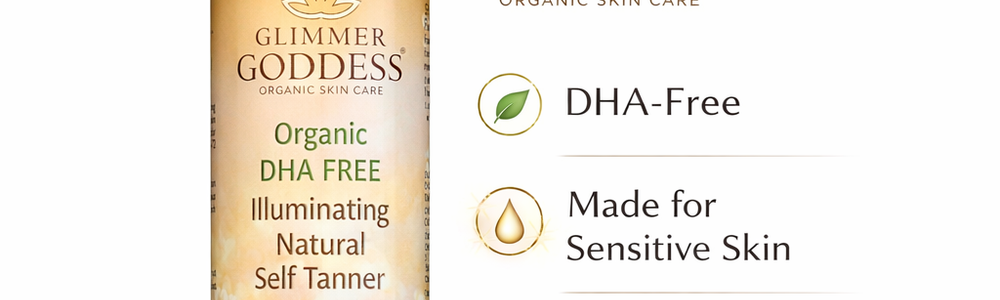
DHA-free means the formula does not use DHA as its tanning agent. Glimmer Goddess® DHA-free products use a gradual tanning approach based on erythrulose rather than DHA.
That difference can change development timing and the way color builds, but “DHA-free” should not be interpreted as universally safer or incapable of causing irritation. The complete formula still matters.
DHA vs. DHA-Free: The Practical Difference
- DHA formulas: generally chosen when faster visible color is the priority.
- DHA-free formulas: useful for shoppers who specifically prefer to avoid DHA and are comfortable with a more gradual build.
- Both: create cosmetic color only and do not replace sunscreen.
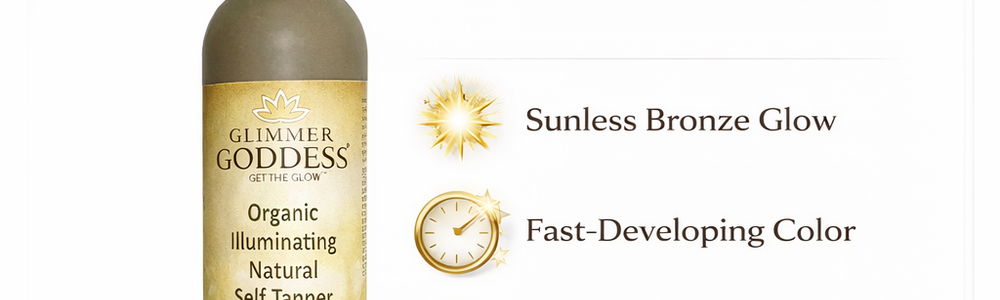
Current examples are Organic Self Tanner – Fast Bronze Glow and DHA-Free Self Tanner for Sensitive Skin – Glow.
Lotion vs. Tanning Drops
Choose Lotion If You Want a Ready-to-Apply Body Product
A lotion format is straightforward: the tanning agent is already distributed through the finished product. It can be easier when you want consistent body coverage without measuring drops.
Choose Drops If You Prefer More Control Over Where You Mix or Apply
Drops can offer flexibility, but follow the specific label rather than inventing your own dilution ratio. The finished product directions determine whether and how the drops should be mixed with another cosmetic.
Current options include Organic Self Tan Drops – Fast Glow and Organic DHA-Free Tanning Drops – Gradual, No-Odor Glow.
Which Format Is Better for the Face?
Use only products whose directions allow facial application. Drops can feel easier to customize for some routines, while others prefer a ready-to-use formula. Avoid the eye area, lips and mucous membranes unless the specific product is intended for those areas.
What FDA Says About DHA Application
FDA allows DHA for external application to the skin but not for areas covered by mucous membranes, and it should not be inhaled or ingested. This is especially relevant to spray-tanning environments, where eyes, lips, nose and inhalation exposure need protection.
Does “Organic Self Tanner” Mean the Tanning Reaction Is Organic-Certified?
No. “Organic” claims relate to qualifying agricultural ingredients and applicable labeling standards; they do not change the chemistry of the color-forming reaction. Evaluate a self-tanner by its full ingredient list, directions and performance rather than assuming “organic” means risk-free.
How to Choose Between the Four Main Options
- Want faster color + lotion? Choose a current DHA-based lotion format.
- Want gradual DHA-free color + lotion? Choose the DHA-free lotion.
- Want faster color + drops? Choose the current Self Tan Drops – Fast Glow.
- Want gradual DHA-free color + drops? Choose the DHA-free gradual drops.
Then follow the exact product directions for amount, development time and frequency.
Patch Testing and Sensitive Skin
Any cosmetic can irritate an individual user. If you have reactive skin or are trying a new formula, patch testing before broad application can help identify obvious sensitivity. Stop use if you develop persistent burning, rash or swelling.
Self-Tanner Myths
“DHA-free means no chance of irritation.”
False. The whole formula—not one excluded ingredient—determines tolerability.
“A self-tan is a safe base tan for the sun.”
False. Cosmetic color does not provide meaningful UV protection unless the product is specifically labeled as sunscreen.
“Drops are always stronger than lotion.”
Not necessarily. Concentration and directions vary by product.
“Darker color means better protection.”
No. Self-tanner color and UV protection are separate.
For technique rather than formula choice, see How to Apply Self Tanner Evenly: Prep, Application & Aftercare. For a broader explanation of DHA-free tanning, see DHA-Free Self Tanner: How It Works & How to Get an Even Glow.
Frequently Asked Questions
Is DHA approved by FDA?
DHA is approved as a color additive for externally applied cosmetics under the conditions FDA specifies. It is not approved for inhalation, ingestion or contact with mucous membranes.
Is DHA-free self-tanner better for sensitive skin?
Not automatically. Some users may prefer it, but sensitive skin can react to many ingredients. Patch test and evaluate the complete formula.
Do self-tanning drops have to be mixed with moisturizer?
Only if the specific product directions say to do so. Follow the label rather than applying a universal mixing rule.
Can I skip sunscreen if I use self-tanner?
No. Use sun protection separately unless the tanning product is also labeled as a sunscreen.
The Bottom Line
Choose DHA versus DHA-free based on tanning system and timing preference, then choose lotion versus drops based on how you like to apply product. None of these formats replaces sunscreen, and “DHA-free” should not be treated as a blanket safety claim.
Sources: FDA: Tanning Products; FDA: Sunless Tanners & Bronzers.