



Turmeric vs. Kojic Acid for Dark Spots
Turmeric and kojic acid are both used in brightening skincare, but they are not interchangeable. Kojic acid directly targets an enzyme involved in pigment production, while turmeric supplies curcuminoids and other plant compounds with broader antioxidant and soothing interest. Evidence and tolerance vary by formula, so the best choice is the one your skin can use consistently alongside daily sun protection.
Quick comparison
| Feature | Turmeric | Kojic acid |
|---|---|---|
| Primary cosmetic role | Antioxidant-focused botanical support | Targets pigment-forming pathways |
| Evidence | Promising but limited and formula-dependent | More directly studied for hyperpigmentation, still formula-dependent |
| Common drawback | Can stain skin, towels, or clothing; botanicals can irritate | Can cause irritation or contact sensitivity |
| Best starting approach | Prepared cosmetic mask or serum used as directed | Low-frequency spot or all-over product used as directed |
What the evidence says about turmeric
A systematic review of human studies found early evidence that oral and topical turmeric or curcumin may influence several skin outcomes, but the authors emphasized that studies were limited and more research was needed. That makes turmeric an interesting supporting ingredient—not a guaranteed dark-spot eraser. Review the turmeric skin-health review on PubMed.
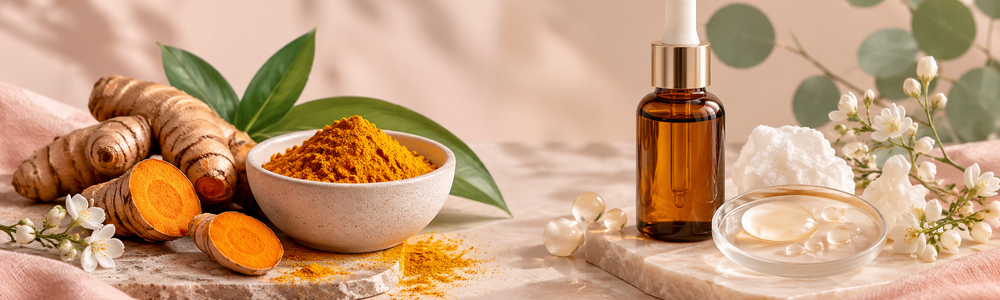
Prepared formulas are preferable to kitchen mixtures because cosmetic products control texture, concentration, preservation, and accompanying ingredients. The active Organic Vitamin C & E Brightening Face Mask includes turmeric in a complete cosmetic mask format.
What the evidence says about kojic acid
Kojic acid is used in cosmetic formulas because it can interfere with tyrosinase, an enzyme involved in melanin formation. Reviews also note formulation and safety considerations, including stability and sensitization potential. See the kojic acid safety and activity review.
A stronger-sounding ingredient is not automatically a better choice. Irritation can make uneven-looking tone harder to manage, particularly in skin prone to post-inflammatory dark marks.
How to choose between them
- Choose turmeric if you prefer a botanical, antioxidant-focused formula and are comfortable with gradual, modest cosmetic goals.
- Choose kojic acid if targeted discoloration is the main concern and your skin tolerates a carefully introduced brightening active.
- Choose neither for now if your skin barrier is irritated, peeling, or inflamed. Restore a simple routine first.
- See a dermatologist for new, changing, irregular, bleeding, or unexplained spots, or for persistent pigmentation that needs diagnosis.
Can you use turmeric and kojic acid together?
They may appear in the same professionally formulated product, but combining separate products can increase complexity and irritation risk. Begin with one product, patch test, and introduce the second only after you understand your skin’s response. Our companion guide explains how to schedule turmeric and kojic acid safely.
What matters more than either ingredient
Broad-spectrum sunscreen helps limit UV-triggered darkening and supports the results of any brightening routine. Gentle cleansing and regular moisturizer also matter because an irritated barrier is less likely to tolerate active ingredients.
For broader choices, see the guides to ingredients for uneven-looking skin tone and face serums for dark spots.
Frequently asked questions
Which works faster?
There is no universal timeline. Kojic acid has a more direct pigment-focused mechanism, but concentration, formula, consistency, sunscreen use, and individual tolerance determine results.
Can turmeric stain skin?
Yes. Turmeric can temporarily stain skin, nails, fabric, and porous surfaces, especially when used as loose powder.
Should either ingredient burn?
No. Stop and rinse if a product causes significant burning, swelling, or persistent redness.