


Anti-Wrinkle Moisturizer: What Helps Fine Lines & What Doesn’t
A moisturizing anti-wrinkle cream can make fine lines look softer by improving hydration, but moisturizer alone does not permanently remove wrinkles. For visible skin aging, dermatologists consistently emphasize daily sunscreen and a well-tolerated moisturizer as the foundation, with retinoids as one of the better-supported topical options for fine lines and texture.
The American Academy of Dermatology recommends starting with sunscreen and moisturizer because both can make a noticeable difference in how aging skin looks. The FDA also distinguishes cosmetic moisturizing claims from drug-like claims such as removing wrinkles or increasing collagen production. See AAD anti-aging guidance and FDA guidance on wrinkle claims.
What can a moisturizer realistically do for wrinkles?
Moisturizer traps water in the skin. That extra hydration can temporarily plump the surface and make some fine lines look less noticeable. It can also improve softness, comfort, and the appearance of dry texture.
What a standard cosmetic moisturizer should not claim is permanent wrinkle removal, structural skin tightening, or guaranteed collagen rebuilding. Those claims cross into a different regulatory category.
What ingredients matter most?
Humectants and emollients
Ingredients such as glycerin, hyaluronic acid, squalane, jojoba oil, and panthenol support hydration and softness. These are especially useful when fine lines are more noticeable because the skin is dry.
Retinoids and retinol
Retinoids have stronger evidence than standard moisturizers for improving fine lines, uneven tone, and texture. They can also irritate, so they are not appropriate for everyone and should be introduced carefully.
Peptides
Peptides are widely used in cosmetic formulas aimed at smoother, firmer-looking skin. Evidence varies by peptide and finished formulation, so they should not be described as equivalent to prescription retinoids or as guaranteed wrinkle-removal ingredients.
Antioxidants
Vitamin C and other antioxidants are often included in anti-aging routines for visible radiance and support against environmental stress. They work best as part of a broader routine that includes daily sun protection.
A verified Glimmer Goddess moisturizer option
The Organic Copper Peptide Moisturizer – Firming & Smoothing is an active Glimmer Goddess product formulated with GHK-Cu copper peptide, aloe vera, squalane, jojoba oil, rosehip seed oil, and provitamin B5.
Its appropriate cosmetic positioning is lightweight hydration for smoother, firmer-looking skin and softer-looking dry fine lines. It is available in a lightly scented essential-oil version and a fragrance-free version with no added essential oils.
It should not be presented as a retinoid substitute, a clinically proven wrinkle-removal treatment, or a product that permanently tightens skin.
Why sunscreen belongs in every anti-aging routine
Sun exposure accelerates visible skin aging. The AAD identifies daily broad-spectrum SPF 30 or higher as a core anti-aging step.
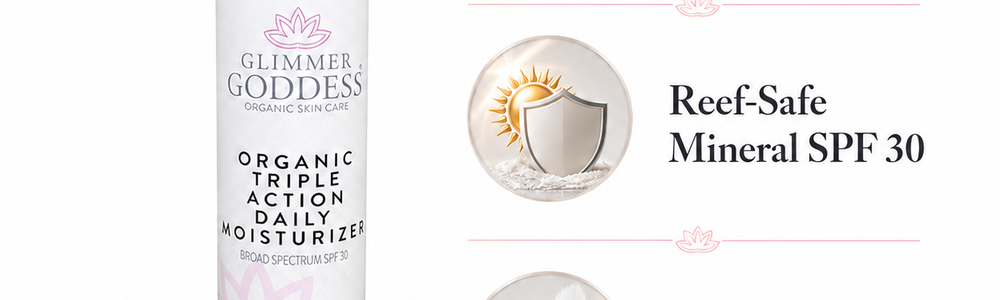
The Triple Action Daily Moisturizer – Organic SPF 30 is a verified GG option that combines daily hydration with mineral SPF 30 using non-nano zinc oxide.
Use sunscreen according to the product directions and reapply as directed when outdoors.
How to build a simple anti-aging moisturizer routine
Morning
- Gentle cleanser.
- Optional antioxidant or targeted serum.
- Moisturizer if needed.
- Broad-spectrum SPF 30 or higher.
Evening
- Gentle cleanser.
- Optional retinoid or targeted treatment if appropriate for your skin.
- Moisturizer.
Using more anti-aging products at once is not automatically better. The AAD warns that combining several products can increase irritation and make signs of aging look more noticeable.
What about retinol?
Retinol is an over-the-counter retinoid commonly used for fine lines, uneven tone, and texture. Start with a lower-strength formula, use it at night, and increase frequency gradually if your skin tolerates it.
If your skin is very dry, reactive, or inflamed, retinoids may not be the right first step. A dermatologist can help determine whether a retinoid fits your routine.
How long should anti-aging products take to work?
There is no universal timeline. Moisturizer can make skin look plumper quickly because of hydration, while many anti-aging products require several weeks or longer to evaluate. The AAD notes that most products take at least about six weeks, and sometimes up to three months, to show their full effect.
What to avoid
- Claims that a cream can produce facelift-like results.
- Products that promise permanent wrinkle removal.
- Using several strong anti-aging actives at once.
- Continuing a product that repeatedly burns or stings.
- Skipping sunscreen while focusing only on nighttime products.
- Assuming a higher price means better results.
Frequently asked questions
Can moisturizer really reduce wrinkles?
Moisturizer can reduce the appearance of some fine lines by increasing hydration and temporarily plumping the skin surface. It does not permanently erase deep wrinkles.
Are peptides better than retinol?
Not universally. Retinoids have stronger evidence for fine lines and texture, while peptides are commonly used for cosmetic smoothing and firmness support. The right choice depends on skin tolerance and the finished formula.
Can sensitive skin use anti-aging products?
Yes, but simpler routines and slower introduction of actives are often better. Fragrance-free moisturizer and daily sunscreen are sensible starting points.
Is sunscreen really anti-aging?
Yes. Preventing UV damage is one of the most important ways to reduce premature skin aging.
Do I need a separate moisturizer if my sunscreen is moisturizing?
Not always. If your sunscreen provides enough hydration and you apply the labeled amount, a separate morning moisturizer may not be necessary.
Related Glimmer Goddess guides
- Facial Moisturizer for Aging Skin: Hydration, Barrier & SPF
- Vitamin C Serum for Aging Skin: What It Can Really Do
- Skincare at Every Age: What Actually Changes
- Explore Skincare by Skin Concern
This article is for general skincare education and is not a diagnosis or substitute for medical care.