



Hyaluronic Acid for Skin: Benefits, Layering & How to Choose
Hyaluronic acid is a humectant used in skincare to support hydration and a smoother, temporarily plumper-looking complexion. It can be useful for dry, dehydrated, mature-looking, combination, and even oily skin—but it works best as part of a complete moisturizing routine rather than as a stand-alone solution.
Dermatology guidance includes hyaluronic acid among useful moisturizing ingredients, especially for dry skin. Published reviews also support topical hyaluronic acid for improving skin hydration, although results depend on the specific formulation, molecular weight, and how the product is used.
What does hyaluronic acid do in skincare?
Hyaluronic acid helps bind water at the skin surface and is widely used in cosmetic products designed to improve hydration, softness, and the appearance of dehydration-related fine lines.
Different molecular weights of hyaluronic acid behave differently in formulations. Lower-molecular-weight forms may penetrate more readily than larger forms, while higher-molecular-weight forms primarily support surface hydration. That does not mean one form is automatically “best”; well-designed products may use more than one form.
A verified Glimmer Goddess hyaluronic acid serum
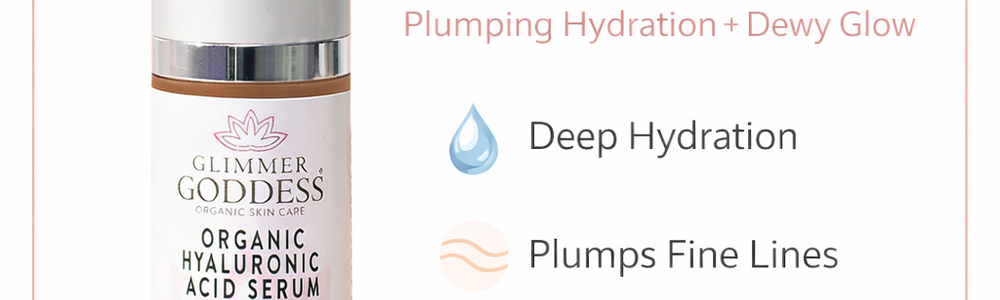
The Organic Hyaluronic Acid Serum – Plumping Hydration 1 oz. is an active Glimmer Goddess product formulated with multi-weight hyaluronic acid along with vitamin C and botanical antioxidants.
Its most appropriate cosmetic role is as a lightweight hydrating serum used before moisturizer to support a dewy, smoother, more hydrated appearance.
It should not be presented as a replacement for moisturizer, as a guaranteed wrinkle treatment, or as proof that hyaluronic acid reaches a specific skin depth in every user.
How to use hyaluronic acid serum
- Cleanse gently.
- Apply a small amount of hyaluronic acid serum.
- Follow with moisturizer to help reduce water loss.
- Use broad-spectrum SPF 30 or higher in the morning.
Applying hyaluronic acid to slightly damp skin can feel comfortable for many people, but it is not a mandatory rule. The more important step is following with an appropriate moisturizer, especially if your skin tends to feel dry or tight.
Does hyaluronic acid replace moisturizer?
No. Hyaluronic acid is primarily a humectant. Moisturizers often combine humectants with emollients and occlusive ingredients that help smooth the skin and reduce water loss.
If your skin is dry, a hyaluronic acid serum can be useful underneath a cream or lotion, but the moisturizer is still the step that helps seal hydration in.
Hyaluronic acid vs glycerin
Both are humectants. Glycerin is a long-established moisturizing ingredient, while hyaluronic acid is valued for its water-binding and film-forming properties. You do not need to choose one over the other; many good formulas use more than one humectant.
For a deeper comparison, see our Hyaluronic Acid vs. Glycerin for Hydration guide.
Can hyaluronic acid be used with vitamin C, niacinamide, or retinoids?
Usually, yes. Hyaluronic acid is commonly paired with other skincare ingredients because its primary role is hydration.
There is no universal requirement to apply vitamin C or retinoids first and then wait several minutes before using hyaluronic acid. Follow the individual product directions and simplify your routine if irritation develops.
Hyaluronic acid by skin type
Dry skin
Use hyaluronic acid under a richer moisturizer. Dermatologists often recommend creams or ointments rather than lightweight lotions when dryness is more severe.
Oily or combination skin
A lightweight hyaluronic acid serum can add hydration without necessarily adding a heavy feel. Follow with a moisturizer texture that suits your skin.
Sensitive skin
Hyaluronic acid itself is generally well tolerated, but the full formula matters. Fragrance, essential oils, preservatives, and other active ingredients may influence tolerance.
Mature-looking skin
Hyaluronic acid can help improve the appearance of dehydration-related fine lines by increasing surface hydration and temporary plumping. It should not be presented as rebuilding lost facial volume or replacing injectable fillers.
What should you look for in a hyaluronic acid product?
- A formula that fits your skin type and routine.
- A texture you will use consistently.
- Supporting humectants or emollients if your skin is dry.
- Fragrance-free positioning if your skin is easily irritated.
- Clear directions without exaggerated claims about penetration or permanent wrinkle reduction.
Do higher concentrations always work better?
No. More hyaluronic acid is not automatically better. Performance depends on molecular weight, formulation, supporting ingredients, delivery system, and how the product feels on your skin.
A serum that is comfortable and layers well may be more useful than one marketed around a high percentage alone.
How quickly should you expect results?
Hydration-related softness and plumping can be noticeable relatively quickly, but there is no universal 3-day, 7-day, or 30-day timeline that applies to every product or user.
Longer-term cosmetic benefits depend on consistent use and the rest of the routine, particularly moisturizer and sun protection.
Common mistakes to avoid
- Using hyaluronic acid without moisturizer when your skin is very dry.
- Assuming a sticky serum is necessarily more effective.
- Choosing a product based only on concentration percentage.
- Stacking multiple hydrating serums that perform the same role.
- Expecting topical hyaluronic acid to work like injectable filler.
Frequently asked questions
Can I use hyaluronic acid every day?
Many people can use it daily if the formula is well tolerated. Follow the individual product directions.
Can hyaluronic acid clog pores?
Hyaluronic acid itself is not generally considered a pore-clogging ingredient, but the complete formula matters for acne-prone skin.
Is hyaluronic acid good for dehydrated skin?
Yes. Dehydrated skin lacks water, and humectants such as hyaluronic acid can support hydration. Follow with moisturizer to help reduce water loss.
Is hyaluronic acid the same as a filler?
No. Topical hyaluronic acid and injectable hyaluronic acid fillers are very different products with different delivery methods and effects.
Do I need multiple molecular weights?
Not necessarily. Multi-weight formulas may be useful, but the finished formulation and overall skin tolerance matter more than marketing language alone.
Related Glimmer Goddess guides
- Hyaluronic Acid Serum: Hydration, Plumping & Realistic Results
- How to Layer Skincare Products: The Right Order for AM & PM
- Skincare for Dry Skin: Products, Routine & Barrier Support
- Explore Skincare by Skin Concern
This article is for general skincare education and is not a diagnosis or substitute for medical care.