




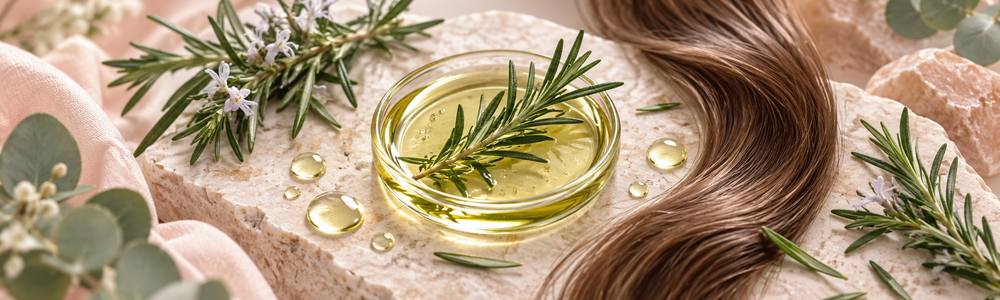
Rosemary Oil for Hair Growth: Evidence, Safety & Routine
Rosemary oil has limited but promising evidence for supporting hair growth, yet it is not a guaranteed remedy and should not replace a diagnosis for new or worsening hair loss. If you try it, use a properly formulated or well-diluted topical product consistently, protect the scalp from irritation, and allow months—not days—to judge the result.
What does the evidence show?
A small randomized trial compared rosemary oil with 2% minoxidil in people with androgenetic alopecia over six months. Both groups showed increased hair counts at six months, and neither showed a significant increase at three months. The study is interesting, but it was modest in size and does not prove that every rosemary formula works like an approved hair-loss medication. Read the PubMed abstract for the rosemary oil trial.
A newer trial studied branded rosemary-lavender and rosemary-castor blends, but formulation-specific results should not be generalized to plain rosemary oil or unrelated products. The evidence base remains much smaller than the marketing conversation around it.
How to use rosemary oil more safely
- Do not apply undiluted essential oil directly to the scalp.
- Choose a ready-made scalp product with clear directions, or dilute rosemary essential oil in a compatible carrier according to qualified formulation guidance.
- Patch test before broad use and stop if you develop burning, swelling, rash, or persistent itching.
- Keep essential oils away from eyes and do not ingest cosmetic rosemary oil.
- Ask a clinician before use during pregnancy, while breastfeeding, for children, or when managing a scalp disorder.
A realistic hair-care routine
Cleanse according to scalp needs
Remove oil, sweat, and buildup without aggressively scratching the scalp. Frequency depends on hair texture, styling habits, and oil production.
Condition the lengths
Hair growth begins at the follicle, but the visible length also needs protection from breakage. Apply conditioner mainly from mid-lengths to ends and detangle gently.
Use leave-on scalp products consistently
Follow the label instead of increasing frequency in pursuit of faster results. Photograph the same part line in the same light every four weeks; daily mirror checks make gradual change difficult to judge.
For shoppers who prefer a coordinated regimen, the current Organic Caffeine Hair Growth System – 3-Step Treatment Set combines three routine steps. It is a cosmetic hair-care option, not a promise to treat alopecia or an alternative to medical evaluation.
When to see a dermatologist
Seek professional help for sudden shedding, smooth bald patches, scalp pain, scarring, intense scale, eyebrow loss, or a rapidly widening part. Hair loss can have many causes, and the correct plan depends on the diagnosis. Bring a list of supplements, medications, recent illnesses, and major stressors to the visit.
Related hair guides
Compare rosemary oil with our guides to hair-growth serums and thinning hair, what caffeine shampoo evidence shows, and tea tree and coconut oil for hair growth.
FAQ
How long does rosemary oil take to work?
The best-known clinical comparison did not show increased hair count at three months but did at six months. Individual results vary.
Can rosemary oil replace minoxidil?
No. One small comparison does not establish equivalence across products or hair-loss conditions. Discuss proven options with a dermatologist.
Can rosemary oil cause shedding?
Evidence is insufficient to call initial shedding an expected response. Stop and seek advice if shedding increases or the scalp becomes irritated.