


Peel-Off Face Masks: Benefits, Risks & Who Should Skip Them
Peel-off face masks form a film that dries on the skin and is removed in one piece or sections. The peeling action can lift surface debris and loose dead skin cells, but that satisfying “peel” does not mean the mask is detoxifying skin or cleaning pores from the inside out. For some skin types, the pulling action can be irritating.
What Peel-Off Masks Actually Do
Most peel-off masks rely on film-forming ingredients that dry into a flexible layer. Removing that film can temporarily make the surface feel smoother. Any brightening or pore-minimizing effect is generally cosmetic and short-term.
For a broader overview of mask benefits and limitations, see Are Face Masks Good for Your Skin? Benefits, Limits & Safe Use.
The Main Risk: Too Much Pulling or Exfoliation
Peeling can tug on the surface of the skin, fine facial hairs and already-irritated areas. If your skin is red, tender, sunburned or over-exfoliated, a peel-off mask can add more discomfort.
Do not exfoliate aggressively immediately before using a peel-off mask. Combining a scrub, acid or other exfoliant with a strongly adhesive mask can increase irritation.
Who Should Be Extra Cautious?
- Very sensitive or reactive skin
- Active eczema or dermatitis
- Rosacea-prone skin
- Open or picked blemishes
- Sunburned skin
- Skin recovering from a peel, laser or other procedure
- Anyone already experiencing burning, stinging or peeling from skincare
If you are unsure which mask format fits your skin, see How to Choose a Face Mask for Your Skin Type & Concerns.
Peel-Off Mask vs. AHA Mask
A peel-off mask exfoliates mainly through physical film removal. An AHA mask uses alpha hydroxy acids to loosen bonds between surface skin cells chemically. These are different mechanisms, and neither should be stacked carelessly with other exfoliants.
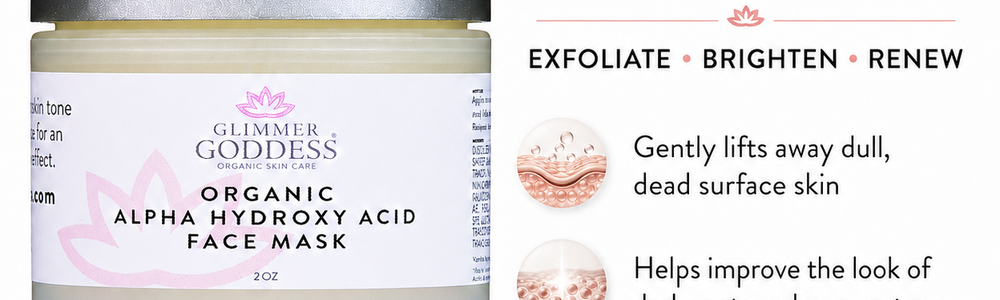
The current Organic AHA Face Mask – Renewing Treatment for Exfoliation & Glow is a current Glimmer Goddess® exfoliating mask option. Follow the product directions and do not assume more frequent use gives faster results.
AHA Sun-Sensitivity Note
The FDA advises that AHAs can increase sun sensitivity while you use them and for up to a week after stopping. Use sun protection as directed when incorporating AHA products.
How to Use a Peel-Off Mask More Gently
- Start with clean, dry skin.
- Do not scrub or acid-exfoliate immediately beforehand.
- Follow the mask’s timing instructions rather than leaving it on “until it feels extra tight.”
- Peel slowly and stop if removal is painful.
- Rinse away residue if directed.
- Follow with a simple moisturizer if your skin feels dry.
When to Skip the Mask Entirely
If the skin is already burning, peeling, cracked or inflamed, skip the peel-off treatment. A simple routine is more appropriate until the skin is comfortable again. Persistent irritation or a rash that does not improve should be evaluated by a healthcare professional.
Frequently Asked Questions
Do peel-off masks pull blackheads out by the root?
No. They can remove surface debris and some material at the follicle opening, but they do not permanently “pull out” the structure that causes comedones.
Are peel-off masks good for sensitive skin?
They can be too irritating for some sensitive skin. Patch testing and choosing a gentler mask format may be more appropriate.
Should I exfoliate before a peel-off mask?
Usually no. Extra exfoliation immediately beforehand can increase irritation.
The Bottom Line
Peel-off masks can be fun and temporarily smoothing, but they are not deep detox treatments. Use them cautiously, avoid stacking exfoliation, and choose a gentler or more controlled mask format when your skin is sensitive or reactive.
Sources: American Academy of Dermatology: Facial masks and skin care; U.S. FDA: Alpha hydroxy acids.