




Vitamin C Serum Concentration: What Percentage Is Best?
The best vitamin C serum concentration is not simply the highest number on the label. Performance also depends on the form of vitamin C, the product’s pH, supporting ingredients, packaging, stability, and your skin’s tolerance. A well-formulated moderate or high-strength serum can outperform a poorly stabilized product with a bigger percentage claim.
Why percentage alone can mislead
Vitamin C appears in several forms. L-ascorbic acid is widely studied but can be unstable and more irritating at acidic pH. Derivatives may be gentler or more stable, yet they require different formulation strategies. Percentages cannot be compared as if every form behaves identically.
Clinical-review literature supports topical vitamin C for antioxidant and appearance-related benefits, while also highlighting substantial differences between formulations.
Who should start lower?
Begin conservatively if your skin is sensitive, dry, easily flushed, or already using exfoliating acids or Vitamin A. A product that causes repeated burning or peeling is not delivering a better result simply because it is strong.
- Patch-test before full-face use.
- Start a few times per week if you are unsure of tolerance.
- Increase gradually only when skin remains comfortable.
- Stop if irritation is persistent or significant.
Where a 20% serum fits
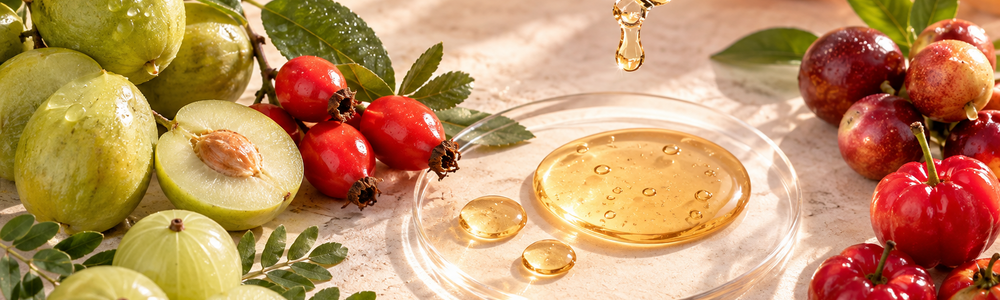
Glimmer Goddess® Organic Vitamin C Serum 20% uses five plant-based vitamin C sources with hyaluronic and ferulic acid. Because “20%” describes the brand’s complete plant-based complex rather than a generic rule for every vitamin C form, it should be judged by the specific formula, directions, stability, and individual tolerance.
How to use vitamin C serum
Morning routine
- Cleanse gently.
- Apply a thin layer of vitamin C serum.
- Follow with moisturizer if needed.
- Finish with broad-spectrum SPF 30 or higher.
Vitamin C complements sunscreen; it does not replace it. Adequate sunscreen application remains essential for preventing UV-related damage and worsening discoloration.
Evening routine
Vitamin C can also be used at night. If your morning routine pills under sunscreen or makeup, evening use may be easier. Consistency matters more than forcing a complicated schedule.
Can vitamin C be layered with niacinamide or resveratrol?
Many modern formulas can coexist. The more practical concern is cumulative irritation or too many layers. If needed, use niacinamide in one routine and vitamin C in another. A resveratrol serum can also be alternated rather than stacked.
Stability and packaging
Heat, light, air, water, and pH can affect vitamin C stability depending on the form. Follow storage directions, keep the closure clean, and do not assume refrigeration is required unless the manufacturer says so.
A dramatic change in color, odor, texture, or performance can signal that the formula is no longer in its intended condition. When in doubt, contact the manufacturer with the batch information.
What vitamin C can realistically do
- Support antioxidant protection.
- Help improve the appearance of dullness and uneven tone.
- Support smoother-looking skin over time.
- Complement—not replace—sun protection.
Vitamin C cosmetics should not be described as curing pigment disorders, erasing wrinkles, or repairing all UV damage.
Frequently asked questions
Is 20% vitamin C too strong?
Not automatically. The form and complete formula determine tolerability. Patch-test and follow the product directions.
Should vitamin C tingle?
It does not need to tingle to work. Ongoing burning or redness is a sign to pause.
How long before results appear?
Cosmetic changes vary. Evaluate consistent use over several weeks while maintaining sunscreen and moisturizer rather than expecting immediate correction.
The bottom line
Choose vitamin C serum by formulation quality, stability, packaging, and tolerance—not percentage alone. Introduce it gradually and pair it with daily sunscreen for a more rational brightening routine.
Source: PubMed — topical ascorbic acid and derivatives in clinical trials.


