


How to Make a Simple Coconut Oil Body Balm Safely
If you want a simple coconut-oil moisturizer at home, make a water-free body balm rather than an improvised lotion. A true lotion contains water and oil. That mixture needs a compatible emulsifier, a broad-spectrum preservation system, controlled sanitation, and stability testing—steps that cannot be replaced by a kitchen recipe or refrigeration.
Why a balm is the safer beginner project
Microorganisms need water to grow. Removing water does not make a homemade product risk-free, but it avoids the preservation challenge at the center of many DIY lotions. The U.S. Food and Drug Administration explains that cosmetics can become contaminated through raw materials, water, poor manufacturing conditions, ineffective preservation, packaging, and consumer use.
A balm is simply a blend of oils and solid fats. It does not add water to skin; instead, it helps soften the surface and reduce moisture loss. Apply it over slightly damp skin for the best feel.
Simple coconut body balm formula
This small test batch uses percentages so you can scale it accurately:
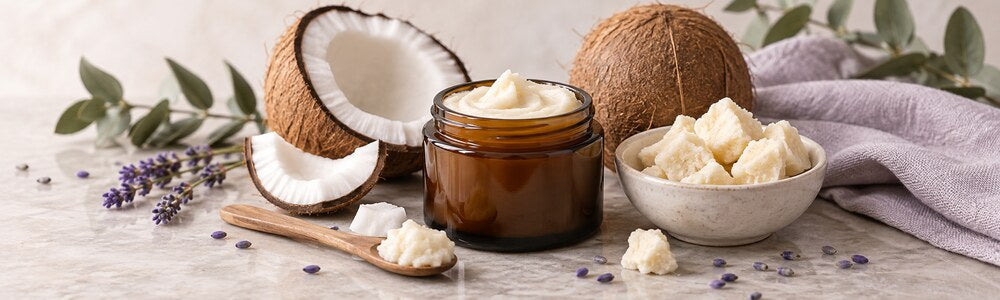
- 60% coconut oil
- 35% shea butter
- 5% jojoba oil
For a 100-gram batch, that is 60 grams coconut oil, 35 grams shea butter, and 5 grams jojoba oil. Leave out water, aloe juice, tea, milk, fresh fruit, and other water-based additions. Do not add sunscreen powders or attempt to calculate SPF at home.
Method
- Wash your hands and clean the work surface. Wash tools and container, allow them to dry fully, then sanitize them with an appropriate method for the material.
- Weigh the ingredients with a digital scale. Avoid measuring by volume when consistency matters.
- Melt the coconut oil and shea butter gently using indirect heat. Remove from heat as soon as the solids are liquid.
- Stir in the jojoba oil. Allow the blend to cool until it begins to thicken.
- For a whipped texture, mix briefly as it cools. Transfer to a completely dry, clean container.
- Label the container with the ingredients and date. Use clean, dry hands or a dry spatula each time.
Storage and signs to discard it
Store the balm tightly closed in a cool, dry place away from direct sunlight. Coconut oil naturally softens in warm rooms and firms in cooler ones; that texture shift is normal. Discard the batch if you notice an unusual odor, visible growth, unexpected color change, gas, separation that was not present initially, or irritation. Because a home batch has not undergone microbial, stability, or compatibility testing, avoid promising a fixed shelf life.
Patch-test before wider use
Apply a small amount to a limited area and observe it before using the balm broadly. Coconut oil can feel rich and may not suit acne-prone facial skin, so keep this recipe for the body unless your dermatologist advises otherwise. Do not use on broken or infected skin.
Prefer a ready-made option?
If you do not want to formulate at home, consider the Organic Whipped Coconut & Vitamin E Body Butter, available in Lemon & Lavender and Unscented options. A lighter alternative is the Organic Silky Dry Body Oil.
Frequently asked questions
Can vitamin E preserve homemade lotion?
No. Vitamin E is an antioxidant used to help slow oxidation of oils; it is not a broad-spectrum antimicrobial preservative for a water-containing formula.
Can I add essential oils?
Fragrance is optional, not necessary. Essential oils can irritate skin and must be used within supplier safety limits. For sensitive skin, keeping the balm fragrance-free is the simpler choice.
Why not call this a lotion?
Lotions are emulsions containing water and oil. This recipe is an anhydrous balm, so it behaves differently and has different safety considerations.
Source: FDA—Microbiological Safety and Cosmetics. This article is educational and does not replace professional formulation or medical advice.