



Comedogenic Ratings: Why They’re Not a Perfect Acne Predictor
If you have acne-prone skin, you have probably seen ingredient lists online that rank oils, butters and esters from “0” to “5” for how likely they are to clog pores. Those charts can look reassuringly precise—but skin is not a laboratory scorecard.
Comedogenic ratings can be a screening clue, not a guarantee. Whether a finished product contributes to breakouts depends on the complete formula, concentration, how much you apply, where you use it and how your own skin responds.
What Does “Comedogenic” Mean?
A comedone is a clogged pore that can become a blackhead or whitehead. In skincare, “comedogenic” is used to describe the potential for an ingredient or product to contribute to clogged pores.
Online rating charts often assign individual ingredients a number. The problem is that an ingredient tested alone does not behave exactly the same way once it is used at a lower concentration inside a finished cleanser, serum or moisturizer. Different test methods can also produce different results.
Are Comedogenic Ratings Useful?
They can be useful as a starting point if you already know that a particular rich oil or heavy texture tends to trigger congestion for you. They should not be treated as a universal rule that says one ingredient will always clog pores—or that a “0” can never cause a breakout.
The American Academy of Dermatology recommends looking for products labeled non-comedogenic, oil-free or won’t clog pores when acne is a concern. These labels are practical shopping signals, but individual reactions can still vary. See the AAD’s acne and cosmetics guidance.
Why the Whole Formula Matters
A finished skincare product is more than its most noticeable oil or butter. Emulsifiers, humectants, solvents, surfactants, film-formers and the percentage of each ingredient influence texture and how the formula sits on skin.
That is why judging a moisturizer only because it contains coconut-derived material, shea butter or another ingredient with a high number on an internet chart can be misleading. Your skin’s response to the finished formula is more informative than one isolated score.
How to Shop When You’re Acne-Prone
- Look for non-comedogenic or oil-free labeling when practical.
- Introduce one new leave-on product at a time so you can identify patterns more easily.
- Use a gentle cleanser. Scrubbing and over-cleansing can irritate acne-prone skin.
- Do not automatically skip moisturizer. A lightweight moisturizer can help maintain comfort and barrier function.
- Watch hair products too. Pomades, oils and styling products that contact the forehead or hairline can contribute to breakouts in some people.
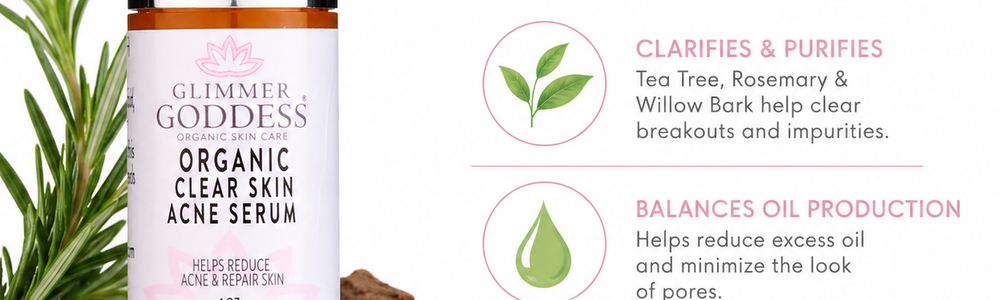
For a targeted option, Glimmer Goddess® Organic Acne Serum – Oil Control & Pore Clearing Treatment is part of our current acne-prone skincare collection. As with any cosmetic product, it should not be presented as a guaranteed cure for acne.
When to See a Dermatologist
If acne is painful, scarring, widespread or persistent despite a consistent routine, a dermatologist can help determine what type of acne you have and which treatments are appropriate. Cosmetic ingredient avoidance alone may not address hormonal, inflammatory or other causes of acne.
The Bottom Line
Comedogenic ratings are best used as context—not as a rigid blacklist. Choose well-formulated products, look for non-comedogenic labeling when acne is a concern, introduce products thoughtfully and pay attention to how your own skin responds.