



Self-Tanner for Sensitive Skin: A DHA-Free Decision Guide
The best self-tanner for sensitive skin is not defined by one missing ingredient. It is a well-labeled formula that suits your history, passes a patch test, and can be applied gradually without discomfort. DHA-free may be a useful preference, but it is not a guarantee against irritation.
What DHA-free means
Dihydroxyacetone, or DHA, is a color additive commonly used to create a tanned appearance by reacting at the skin surface. A DHA-free tanner uses a different color system. That can change development time and tone, but sensitivity can still occur from fragrance, preservatives, botanicals, or other ingredients.
The DHA Free Self Tanner for Sensitive Skin – Glow is designed to build gradually over three to five days. Compare that slower approach with the Organic Self Tanner – Fast Bronze Glow, which uses DHA and erythrulose for color that begins developing within hours.
Patch test before the event
- Follow the product’s own patch-test directions when provided.
- Choose a small, discreet area of intact skin.
- Apply the same amount and preparation method you plan to use.
- Wait the stated development time and watch for delayed irritation.
- Do not proceed if you notice persistent burning, itching, swelling, or rash.
Apply gently and evenly
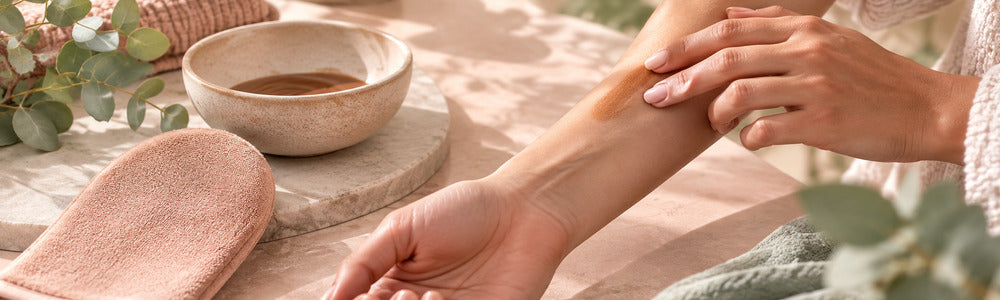
Exfoliate conservatively rather than scrubbing aggressively. Moisturize dry elbows, knees, ankles, and hands first, then apply a thin layer with a mitt. Build color over multiple applications instead of using a heavy first coat. Avoid broken or freshly shaved irritated skin.
Important sunless-tanning limits
Sunless color does not protect against UV radiation unless the product is separately labeled with SPF. FDA guidance also explains that DHA is approved for external application and should not contact the eyes, lips, or mucous membranes. Review the FDA guidance for sunless tanners.
Frequently asked questions
Is DHA-free always gentler?
No. It removes one ingredient from consideration, but the entire formula and your individual sensitivities still matter.
Can I apply self-tanner to irritated skin?
Wait until skin is calm and intact. If you have eczema, an active rash, or a history of severe reactions, ask a dermatologist before use.